





How a Fast-Growing AI Company Rebuilt from the Stack Up

The problem wasn’t the model—it was everything around it.

They had ambition, and it showed.

This team of engineers had built something remarkable: intelligent agents that could parse documents in seconds, respond around the clock, and surface insights from oceans of unstructured data.

But there was a catch.

It didn’t scale.

What looked Right Was Already Breaking

The agents worked beautifully in demos. The models performed under test conditions. But when it came time to embed them in secure enterprise environments, the system began to crack.

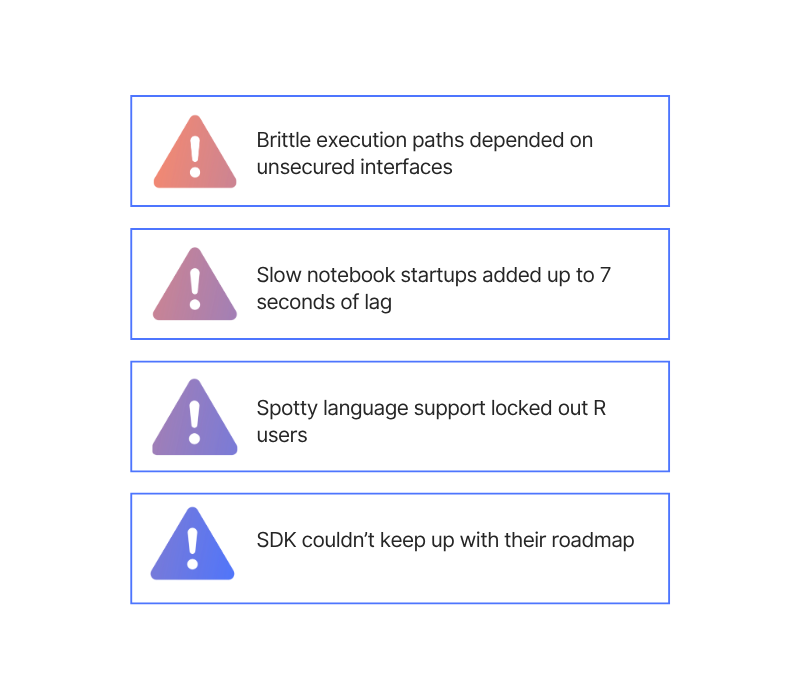
  1. Notebooks stalled.
  2. Integrations failed quietly.


Security teams had no visibility into what the agents were doing behind the scenes.

The team had built an engine with enormous potential—fast, powerful, endlessly capable. But the frame couldn’t support the speed.

That’s when they called us.

Where It Broke

You could sum it up in one work: fragility.

They needed better infrastructure.

What We Did

We started where most vendors don’t: under the hood.

Agentic Execution

We engineered a headless Jupyter extension—no UI, no friction—so agents could run invisibly and securely. That single change enabled them to operate safely inside the company’s AI platform, without interrupting core workflows.

Performance, Unlocked

By stripping unnecessary loading behaviors, we cut cold-start times dramatically. That seven-second lag? Gone.

R Support, Upgraded

We brought R support to full parity with Python using RPy2 and IRKernel. Analysts no longer had to switch languages or hack together workarounds.

SDK, Rebuilt for Scale

We re-architected the SDK using Fern, hardening its interfaces and standardizing data handling across Arrow, Parquet, Matplotlib, and Plotly.

UI, Embedded in Reality

We customized and compressed the Jupyter UI to sit inside the company’s multi-tabbed interface. The notebooks became the platform.

What Made It Work

We didn’t ask this team to change how they operate. We met them where they were—and gave their agents the infrastructure to match their intelligence.

We made their product faster, safer, more auditable, and easier to control because we listened first.

Before and After: The Stack Now

Tooling We Reinforced

Jupyter Notebooks

Core agent workspace

Docker

Secure, containerized execution

RPy2, IRKernel

First-class R support

Fern

Robust SDK tooling

Arrow, Parquet

Efficient data transport and storage

Jamsocket

High-reliability execution backend

Matplotlib, Plotly

Trusted visualization libraries

Streamlit

Lightweight UI prototyping

How This Matters

People often assume AI fails because the model isn’t good enough. But in practice, it fails when everything around the model can’t scale.

We helped this team go from potential to production—from fragile demos to robust deployments—without rewriting their vision.

They built intelligence.

We built the scaffolding.

If You’re Building Something Brilliant—And It Still Keeps Breaking…

You need someone who’s solved this problem before.

Let’s talk.

Share:

Related Articles

Davos, Sovereignty, and the Quiet Power of Europe’s Open Source AI

Every January, the global economic conversation moves to a small alpine town in Switzerland. Heads of state, founders, and technologists gather in Davos to debate the future. This year, beneath the familiar headlines about geopolitical tension and economic uncertainty, another theme dominated nearly every private conversation: artificial intelligence.

Read More