
Recently Animesh Jain from Meta published a blogpost about the work we are doing in Dynamo. The gist of it is that we are refactoring Dynamo’s object model to mirror CPython PyTypeObject slots. Given that, I thought it would be interesting to write a follow-up post about one small corner of that work: the tp_as_number slot, and how binary operations are dispatched in CPython.
Background
TorchDynamo
TorchDynamo (or simply Dynamo) is the JIT compiler that PyTorch uses to make PyTorch programs faster. Dynamo hooks into the eval frame API (PEP 523) to intercept the Python bytecode before it runs and symbolically trace it to an intermediate representation called FX Graph. It is worth mentioning that Dynamo is not a general-purpose Python implementation. It is designed to optimize a very specific class of programs and it works quite well for that purpose.
PyTypeObject and tp slots
Every Python object has a type, and every type is represented internally by a PyTypeObject. For instance, the int and str types below are represented by PyTypeObject instances:
type(42)    # <class 'int'>
type("hi")  # <class 'str'>
The PyTypeObject is a large struct that defines a type’s behavior through slots. Each slot is a pointer to a function that implements a specific behavior of a type. For example, the tp_as_number slot is used for types that support numeric-style operations. The tp_iter and tp_iternext slots are used for types that support iteration. The tp_call slot is used for callable types, and so on.
The tp_as_number slot
The tp_as_number slot is a pointer to a PyNumberMethods struct, which contains function pointers for various numeric operations:
typedef struct {
    binaryfunc nb_add;
    binaryfunc nb_subtract;
    binaryfunc nb_multiply;
    // ...
    binaryfunc nb_inplace_add;
    // ...
    unaryfunc nb_index;
    // ...
} PyNumberMethods;
One such example of a binaryfunc is the nb_or field, which is the function used to implement the | operator.
The name can be a bit misleading, because the tp_as_number slot is not just for numeric types (int, float, etc), but also for other types that support binary and unary operations. For example, set intersection set1 & set2 is implemented by the nb_and slot. Dict merge dict1 | dict2 is implemented by nb_or, among others.
Motivation
Dynamo was originally designed to cover a subset of Python programs that matter most for PyTorch. That design worked well enough to support many important workloads, but it became more difficult to extend to support more Python features. One such example is the dict.__or__ implementation added in 2025 which was recently replaced by the nb_or slot:
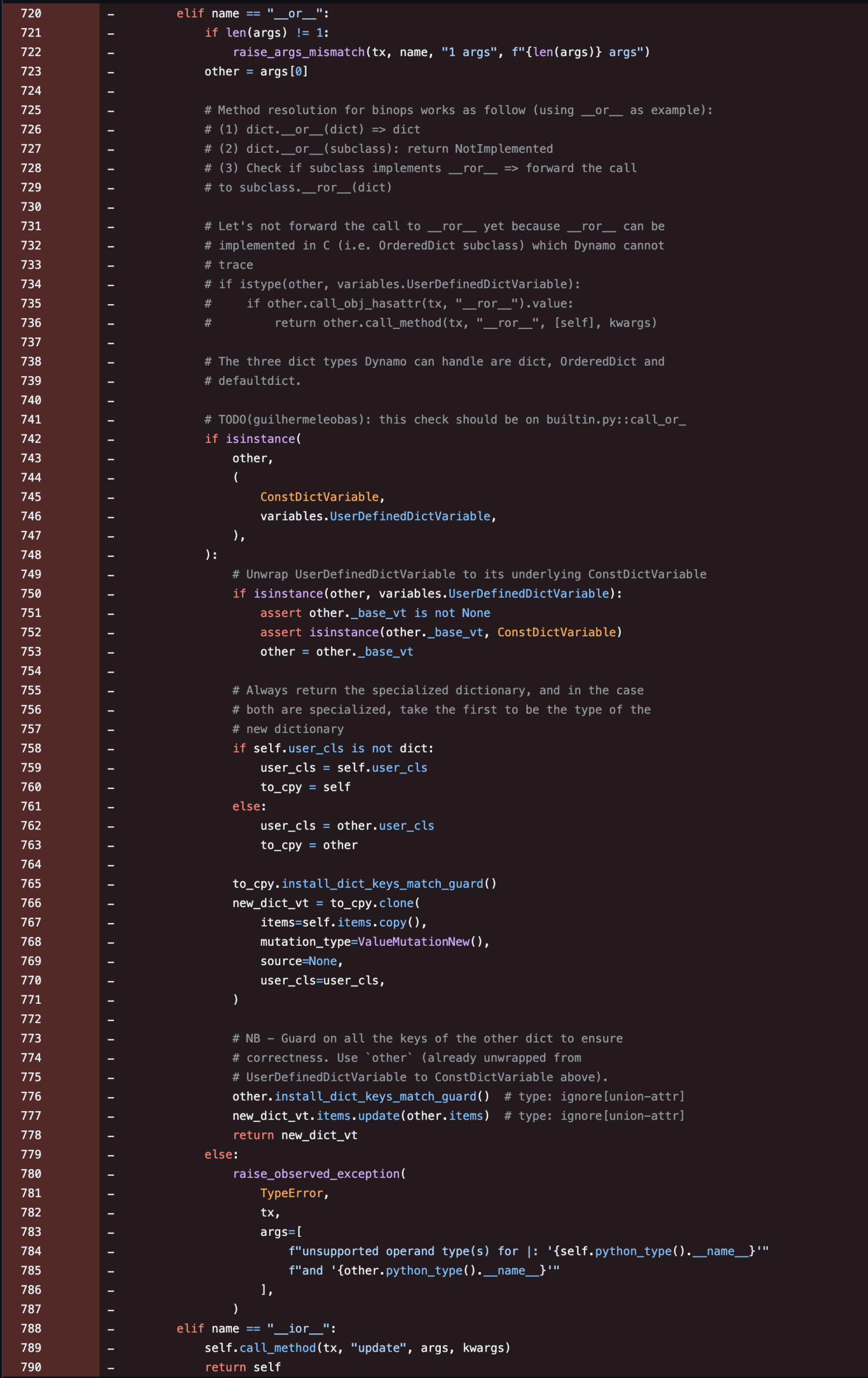
Dynamo’s ad-hoc impl. of dict.__or__ before the slot-based rewrite
The image above shows the previous implementation of dict.__or__ in Dynamo. It tries to do many things at once: inspect the type of other for subclasses, check for the presence of __ror__ and so on. This snippet almost certainly misses some corner cases that are not caught by the test suite. It also shows we are trying to mimic parts of the dispatch logic that CPython gets for free but in a completely ad-hoc way.
Over time, some of the core logic became less about well-defined rules and more about accumulating special cases. When Dynamo discovered a new gap with CPython, we would often patch that gap directly. This was pragmatic, and I have written my fair share of this kind of code, but it made the codebase much harder to reason about.
The tp_* slot work is an attempt to replace some of the ad-hoc logic with a model based on the same rules CPython uses, improving both behavior coverage and code clarity.
The dispatch algorithm
For a single binary operation left | right, it is natural to think CPython simply calls left.__or__(right). This is almost right, but there is a catch: in some cases, the right-hand side gets the first chance to handle the operation.
Internally, binary operations are implemented as PyNumber_* functions in abstract.c, which get called when the BINARY_OP opcode is executed. The dispatch is generally handled by the binary_op1 function, which roughly follows the algorithm below:
- Look up the slot for
left. - Look up the slot for
right. - If
rightis a subclass ofleft, and it provides a different implementation, tryrightfirst. - Otherwise, try
leftfirst. - If the first attempt returns
NotImplemented, try the other side. - If every implementation returns
NotImplemented, raise aTypeError.
This is essentially the algorithm implemented by binary_op1 in CPython. This function works on slots like nb_or, nb_add, etc.
The SLOT1BIN macro
SLOT1BIN is the glue that allows user-defined types to participate in the binary protocol. Builtin types like int, dict, and set define their slots directly in C, but Python-defined classes expose dunder methods instead. The SLOT1BIN / SLOT1BINFULL macros are responsible for generating wrapper functions to bridge the gap between the slots and the dunder methods.
class A:
    def __or__(self, other):
        return "A.__or__"

    def __ror__(self, other):
        return "A.__ror__"
For the class A, once binary_op1 dispatches the call to A.tp_as_number.nb_or, it will go through the generated wrapper which maps that slot invocation back to A.__or__.
The last detail from the SLOT1BIN macro is how it handles the reflected method (__ror__ in this case). The wrapper calls the reflected method in two cases.
Case 1: Right is a subclass of Left and Right.__ror__ is overridden.
class Left:
    def __or__(self, other):
        return "handled by Left"

class Right(Left):
    def __ror__(self, other):
        return "handled by Right"

print(Left() | Right())  # "handled by Right"
Case 2: Left.__or__ returns NotImplemented and Left and Right are different types.
class Left:
    def __or__(self, other):
        return NotImplemented

class Right:
    def __ror__(self, other):
        return "handled by Right"

print(Left() | Right())  # "handled by Right"
I suggest reading the implementation of SLOT1BINFULL to understand how CPython implements this logic.
The new dict.__or__ implementation
Recall that tp_as_number points to a PyNumberMethods struct, and nb_or is the entry in that struct used by the | operator. The nb_ prefix is the naming convention for the category of “number methods”. With the new slot-based implementation, the dict.nb_or slot becomes a straight translation of the CPython implementation to Python:
static PyObject *
dict_or(PyObject *self, PyObject *other)
{
    if (!PyDict_Check(self) || !PyDict_Check(other)) {
        Py_RETURN_NOTIMPLEMENTED;
    }
    PyObject *new = PyDict_Copy(self);
    if (new == NULL) {
        return NULL;
    }
    if (dict_update_arg(new, other)) {
        Py_DECREF(new);
        return NULL;
    }
    return new;
}
CPython impl. for dict tp_as_number.nb_or (source)
And here is the equivalent Dynamo implementation:
def nb_or_impl(
    self,
    tx: Any,
    other: VariableTracker,
    reverse: bool = False,
) -> VariableTracker:
    self_, other_ = (other, self) if reverse else (self, other)
    if pydict_check(self_) and pydict_check(other_):
        new = self_.call_method(tx, "copy", [], {})
        new.call_method(tx, "update", [other_], {})
        return new
    return ConstantVariable.create(NotImplemented)
Dynamo impl. of dict nb_or (source)
The binary_op1, SLOT1BIN and nb_or were added to PyTorch in the pull request #181326 as part of the effort to support not just nb_or but the tp_as_number slot in general.
The slot-based implementation is useful for a few things:
- The new behavior is consolidated in a shared dispatch mechanism instead of being scattered in many ad-hoc ones across the codebase
- The translation from C to Python can be partially done by an LLM
- One could validate the implementation using the CPython tests
The generated code still needs to be reviewed and tested, but it can significantly speed up porting the remaining slots.
Leveraging the CPython test suite
We use the CPython tests to validate the slots implementation. CPython has a test suite containing more than 750 test files that span from I/O to the standard library, representing more than 30 years of development effort in implementing the Python interpreter.
Last year I started an effort to port a subset of those tests to Dynamo. PyTorch currently runs 4,729 tests which are spread across 45 test files. It is a small subset, but it covers many of the core behaviors that Dynamo needs to model: builtin types, data structures, exceptions, and math operations.
For more information, check out the dashboard I maintain on Streamlit, which tracks the progress of running the CPython tests on PyTorch main branch. When this effort started, only 37% of those tests were passing. At the time of writing this post, this number is close to 50%.
Conclusion and next steps
The port of binary_op1 / SLOT1BIN to Dynamo was implemented in the pull request #181326. This work was part of the effort to add nb_or as the first tp_as_number slot supported by Dynamo.
This work aligns with the vision described in Animesh’s blogpost: to move from an implementation that works by accident to a model that we can reason about and validate against CPython source code and tests. The next steps involve porting the remaining slots in PyTypeObject and expanding the test coverage to ensure we are correctly modeling CPython’s behavior.